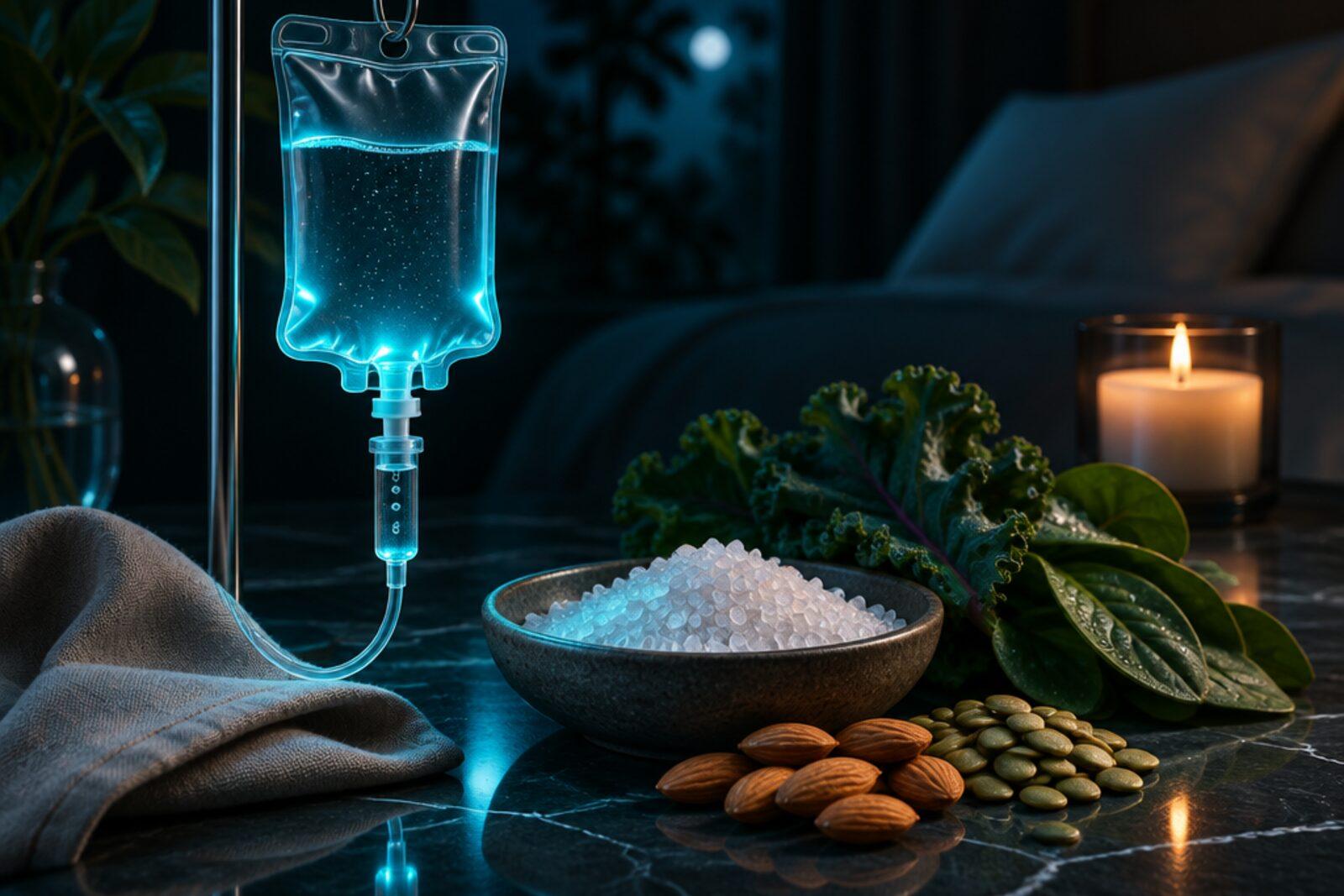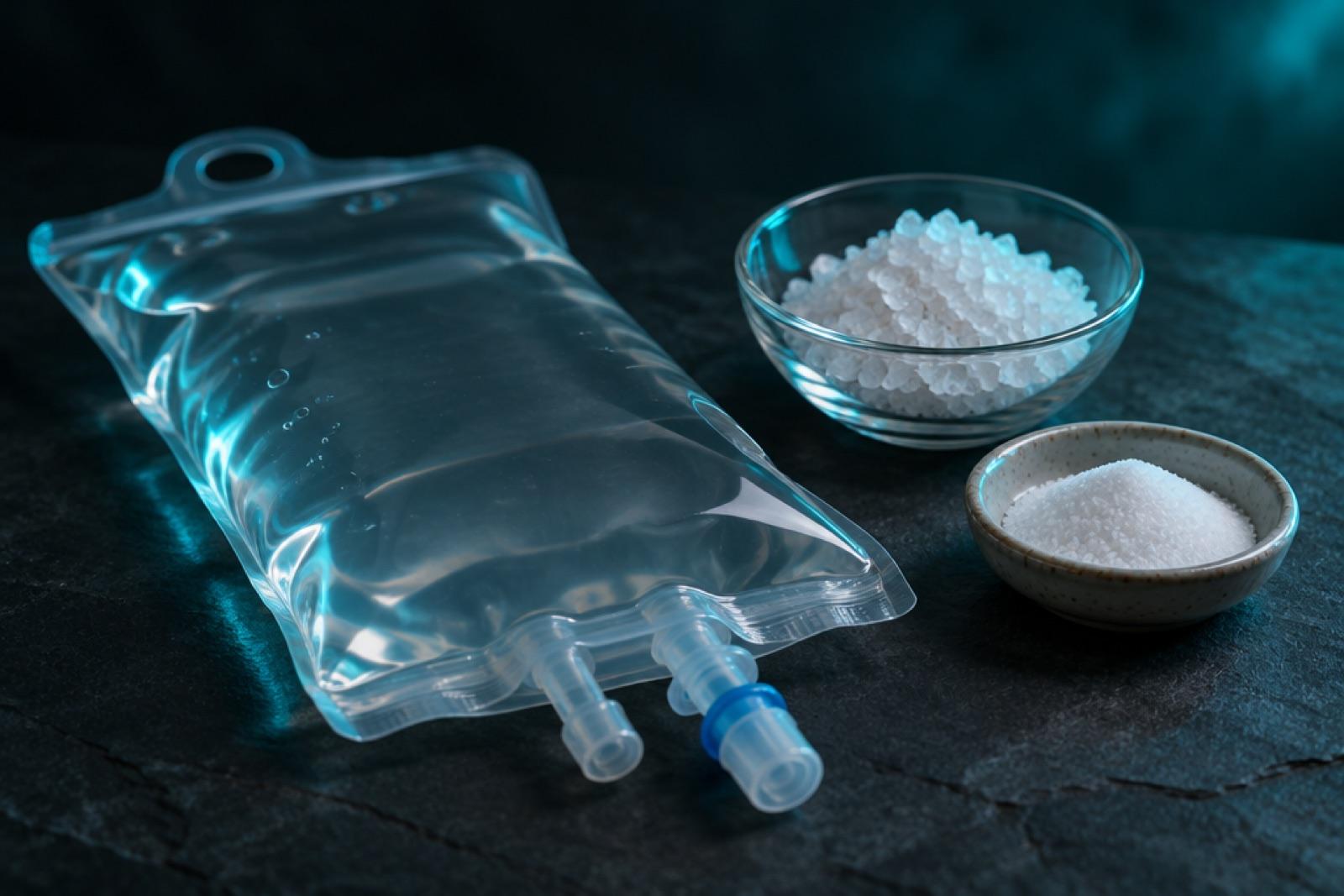
People ask us some version of this question at almost every visit. "So it's just salt water?" "Is that the same salt I cook with?" "Is this the same bag they gave me in the ER?" They are good questions, and the honest answers are: sort of, no, and mostly yes. Here is how IV saline compares to the salt in your kitchen, what is in the bag a hospital hangs, and what a mobile IV nurse hangs instead.
The Short Answer
IV saline is sodium chloride dissolved in sterile water at a precise strength, made as a regulated pharmaceutical product. The sodium chloride itself is the same compound as table salt, but that is where the similarity ends. Table salt and sea salt are food. Saline is a sterile injectable fluid made to match your blood. You cannot make one from the other, and no one should ever try.
The bag of clear fluid a hospital hangs is usually normal saline, though hospitals also use a few related fluids depending on the reason you are there. A mobile IV company uses the same category of sealed, commercially made saline bags. The difference between a hospital IV and a wellness IV is not the bag. It is why it is being given, what is added to it and the setting.
Is Saline the Same as Regular Table Salt?
The chemistry is the same. The product is not.
Normal saline is 0.9 percent sodium chloride in sterile water, which works out to about 9 grams of salt in a 1-liter bag. Sodium chloride is the compound in ordinary table salt. So in the narrowest sense, yes, a saline bag contains the same salt you shake onto dinner.
Here is why that does not make it the same thing:
- Purity. The sodium chloride in saline is pharmaceutical grade, which means it is tested to be free of the contaminants that are harmless to eat but not to inject. Table salt usually contains anti-caking agents so it pours, and most table salt in the United States has iodine added. Neither belongs in a vein.
- Sterility. Saline is made, sealed and tested as a sterile product. Table salt is not sterile, and neither is tap water or a kitchen.
- Precision. The 0.9 percent strength is not approximate. It is mixed and verified to match the concentration of dissolved salts in your blood, which is what lets it go into a vein without harming blood cells. A spoonful in a glass is a guess.
- Regulation. In the United States, IV saline is a prescription drug product made under FDA manufacturing rules, with a lot number and expiration date printed on every bag. Salt is a food.
So the answer is: same ingredient, entirely different product. If you have ever wondered whether you could skip the nurse and make your own, the answer is an emphatic no. Injecting any homemade solution is dangerous, and nothing goes into an Elite client's vein that did not arrive sealed from a licensed medical supplier.
Is Saline the Same as Sea Salt?
No, and in two ways.
First, sea salt is not pure sodium chloride. It is evaporated seawater, so it carries small amounts of other minerals, such as magnesium, calcium and potassium, along with whatever else was in the water. That variability is part of its appeal in cooking and exactly why it is not used to make an injectable. Normal saline contains sodium chloride and water, nothing else, in a measured amount.
Second, the strength is very different. Seawater is roughly 3.5 percent salt, close to four times the concentration of normal saline. Fluid that salty is not in balance with your blood; it would pull water out of your cells rather than add fluid to your circulation. Normal saline is mixed to 0.9 percent precisely so that it is isotonic, meaning it matches your blood and can be added directly.
If you have seen the word "sea" attached to a saline product, it was almost certainly a nasal spray or a wound rinse, not an IV fluid. Those are different products for different jobs.
Is the Bag of Fluid at the Hospital Saline?
Usually, yes. The clear bag that hangs beside most hospital beds is 0.9 percent sodium chloride, the same normal saline described above. It is the most common IV fluid in medicine because it is the one that most closely matches blood and can be used for so many purposes: hydration, carrying medications, keeping an IV line open.
It is not the only fluid hospitals use. Depending on why you are there, a clinician may order:
| Fluid | What it is | Why it might be chosen |
|---|---|---|
| Normal saline (0.9% sodium chloride) | Salt and sterile water, matched to blood | General hydration, a carrier for medications, keeping a line open |
| Lactated Ringer's | Sodium, chloride, potassium, calcium and lactate in water | A balanced fluid often used around surgery or for larger volumes |
| Dextrose solutions (such as D5W) | A small amount of sugar in sterile water | When a little glucose is wanted along with fluid |
| Half-normal saline (0.45%) | A weaker salt solution | Specific situations set by the physician |
Every one of those bags is labeled with its exact contents, and the label is what the nurse checks before hanging it. If you want to know what is in your bag at any time, in a hospital or at home, you can ask your nurse to read it to you.
Do Mobile IVs Use the Same Saline Bags as Hospitals?
Yes. The bags a mobile IV nurse hangs are the same kind of commercially manufactured, sterile, single-use normal saline that hospitals use. They are made by pharmaceutical manufacturers under FDA rules and come through licensed medical suppliers, sealed, lot-numbered and dated. There is no "wellness grade" saline. There is one product, and it is a drug.
The people hanging it are also the same kind of people. Elite's clinical team is made up of licensed nurses and medics, many of whom have spent years placing IVs in hospitals, emergency rooms and ambulances. The technique for choosing a vein, cleaning the skin, placing the catheter and running the line is the one they were trained to use anywhere else.
What actually differs between a hospital IV and a wellness IV:
- Why it is being given. A hospital uses IV fluid to treat illness and injury. A wellness drip is elective, for healthy adults who have passed a screening, and it is not a substitute for medical care.
- What is added. On Elite's menu, saline is the base that vitamins, minerals and amino acids are mixed into. A hospital bag may carry prescription medications instead, or nothing at all.
- Volume and pace. A wellness infusion is typically a 500 milliliter or 1 liter bag run by gravity at a comfortable pace. Hospitals can run larger volumes faster, often with a pump, because a physician has decided a patient needs that.
- The setting. Your couch instead of a bed with rails. Our nurse stays with you for the whole infusion either way.
How to Read the Bag Yourself
Every saline bag carries the same basic information, and your nurse is happy to show you:
- The name of the fluid. On a normal saline bag it reads "0.9% Sodium Chloride Injection, USP." The USP mark means it meets the United States Pharmacopeia standard for that product.
- The volume. Usually 500 mL or 1,000 mL for a wellness drip.
- A lot number and expiration date. These let the manufacturer and the nurse trace exactly which batch the bag came from. An expired bag is not used.
- "Single dose" and "sterile." Once a bag is opened, it is used for one person, then discarded.
If anything has been added to your drip, the nurse will tell you what and how much before it is started, and it matches the ingredients listed for that drip on our infusion menu.
Why the Salt Matters at All
It is fair to ask why a bag of salt water needs this much explanation. The reason is that the salt is the safety feature. Plain sterile water run into a vein would be far more dilute than blood and would draw water into red blood cells until they burst. The 0.9 percent of sodium chloride is what makes the fluid match your blood and lets it do its job: adding fluid volume, delivering sodium along with it and carrying whatever else is in the bag into circulation at a controlled pace. We cover that in more detail in what's inside an IV saline bag.
That is also why the bag is only part of the picture. Extra sodium and fluid are handled differently by people with kidney, heart or fluid-balance conditions, which is why Elite screens every client before a bag is hung and why some people are not candidates for an IV at all. Our post on whether IV therapy is safe walks through that screening.
The Same Bag, a Different Day
The next time you watch a clear bag drip, you will know what it is: sodium chloride and sterile water, matched to your blood, made the same way whether it is hanging in an emergency room or in your living room. The salt in it shares a name with the salt in your kitchen and almost nothing else.
Want to see what gets added to the saline? Book an Elite Infusions + Wellness appointment or contact our team and a nurse will walk you through the menu.
Educational note: This content is for general education and is not medical advice. IV therapy is provided only after appropriate screening. If you are experiencing severe weakness, confusion, fainting, chest pain, shortness of breath, ongoing vomiting or signs of heat illness, seek urgent medical care rather than booking a wellness infusion. Individual results vary.